You are here: »
Home » Posts filed under Amazing Number Facts No
a3 + b3 = c3 |
a3 + b3 = c3 + d3 |
This has no solutions when a, b and c are whole numbers |
- 13 +123 = 93 + 103
- 93 +153 = 23 + 163
- Can you find others?
|
a3 + b3 + c3 = d3 |
a4 + b4 = c4 + d4 |
- 33 +43 + 53 = 63
- 13 +63 + 83 = 93
- Can you find others?
|
- 74 +2394 = 1574 + 2274
- 594 +1584 = 1334 + 1344
- Can you find others?
|
---
- Pi is 3.14159265358979323846....
- The decimal digits do not stop and they do not repeat. Pi is irrational.
- At present Pi is known to an incredible 206,158,430,000 decimal places after the point.
- The calculation was completed on 20th September 1999.
- In case you need to know, the 206,158,430,000th digit (not counting the initial 3) is 3.
- The computer used was a HITACHI SR8000 at the Information Technology Center, Computer Centre Division (old Computer Centre,) University of Tokyo. Congratulations should be sent to : kanada@pi.cc.u-tokyo.ac.jp
- Do each of the digits occur equally often?
- The following tables gives the number of each of the digits that occur in the first 6 billion decimal places:
In numerical order
0 |
599963005 |
1 |
600033260 |
2 |
599999169 |
3 |
600000243 |
4 |
599957439 |
5 |
600017176 |
6 |
600016588 |
7 |
600023761 |
8 |
599975659 |
9 |
600007998 |
|
In order of frequency
1 |
600033260 |
7 |
600023761 |
5 |
600017176 |
6 |
600016588 |
9 |
600007998 |
3 |
600000243 |
2 |
599999169 |
8 |
599975659 |
0 |
599963005 |
4 |
599957439 |
|
1 is the most frequently occurring digit making up 10.00055433% of the total. - 4 is the least frequent making up only 9.99929065% of the 6 billion digits.---One over Primes
1/2 | 0.5 | Terminates |
1/3 | 0.33333... | Repeating block: 1 digit |
1/5 | 0.2 | Terminates |
1/7 | 0.1428571428... | Repeating block: 6 digits |
1/11 | 0.090909... | Repeating block: 2 digits |
1/13 | 0.0769230769... | Repeating block: 6 digits |
1/17 | 0.05882352941176470588... | Repeating block: 16 digits |
1/19 | 0.0526315789473684210526... | Repeating block: 18 digits |
1/23 | 0.04347826086956521739130434... | Repeating block: 22 digits |
Notice that for some primes the size of the repeating block is 1 less than the prime. - These are called Golden Primes or Long Primes.
- 2, 3, 5, 7, 11, 13, 17, 19, 23, 29, 31, 37, 41, 43, 47, 53, 59, 61, 67, 71, 73, 79, 83, 89, 97
- 9 out of the 25 primes less than 100 are golden, that's 36%.
- Emil Artin made a conjecture that in the long run the proportion of primes that are golden is given by:
-
- Can you spot the pattern in the terms of this product?
- You might like to calculate the first few terms of this product and compare it with 36%.
- What are the next few golden primes?---
- We all know and love the Positive Integers:
1 |
2 |
3 |
4 |
5 |
6 |
7 |
8 |
9 |
10 |
11 |
12 |
13 |
14 |
... |
1 is the first positive integer. It is special since it divides all the positive integers.
1 |
2 |
3 |
4 |
5 |
6 |
7 |
8 |
9 |
10 |
11 |
12 |
13 |
14 |
... |
2 is the first prime number. Now find all the multiples of 2 (even numbers): - Positive Integers other than 1 which are not prime numbers are called Composite Numbers.
1 |
2 |
3 |
4 |
5 |
6 |
7 |
8 |
9 |
10 |
11 |
12 |
13 |
14 |
... |
This leaves 3 as the next prime number. Now find all the multiples of 3: - We now have identified all the multiples of 2 and 3. This gives 5 as the next prime:
1 |
2 |
3 |
4 |
5 |
6 |
7 |
8 |
9 |
10 |
11 |
12 |
13 |
14 |
... |
Continue this process by identifying the multiples of 5 then finding the next prime and then its multiples and so on:
1 |
2 |
3 |
4 |
5 |
6 |
7 |
8 |
9 |
10 |
11 |
12 |
13 |
14 |
... |
Try this process with the numbers 1 to 100 crossing out the unwanted multiples of each new prime. - At what stage are there no more multiples to cross out?
- This sifting out of the composite numbers was first done by Eratosthenes (275-194BC).
- It is called the "Sieve of Eratosthenes".---A Prime Rich Decade
In the decade 1990-1999 three of the years were prime:- 1993 , 1997 and this year 1999.
- Since all primes other than 2 and 5 end in either 1, 3, 7 or 9 then this decade has been RICH in primes.
- The most prime years possible in a decade is four. The last such VERY RICH decade was 1800-1899:
- 1801, 1803, 1807 and 1809 are all prime.
- An amazing fact is that there has been no VERY RICH decade for one hundred years.
- In fact the current RICH decade is the first since 1780-1789:
- 1783, 1787 and 1789 are all prime.
- So how long do you have to wait until the next RICH or VERY RICH decade? Will it be in your lifetime?
- The good news is that if you are of school age just now you may just experience the next VERY RICH decade.
- However the bad news is that you will definitely not experience another RICH decade like the present one.
- So when are they? Search for yourself in the The Prime List.
---
- Cabalistic Numerology
- If the letters of the alphabet are assigned numerical values:
- A=1, B=2, C=3 etc then words take on values.
- For example MADRAS COLLEGE has a value of
- 13+1+4+18+1+19+3+15+12+12+5+7+5 = 115
- Also HAD GOOD MATHS has a value of
- 8+1+4+7+15+15+4+13+1+20+8+19 = 115
- Is this a coincidence or is there some deeper message here?!!
- Can you produce similar deep messages using your own school name?
- ONE gives 15+14+5 = 34 which is certainly not ONE.
- Let's assign different values to the letters so that it does give ONE:
- O=23, N=-22 and E=0 so that now you get:
- ONE gives 23+(-22)+0 = 1 which is definitely ONE.
- Can we now get TWO correct? Make T=32 and W=-53:
- TWO gives 32+(-53)+23 = 2 which is definitely TWO.
- For THREE try H=3 and R=-32.
- Can you continue assigning values that make the sums for FOUR, FIVE, SIX, SEVEN etc work out correctly?
- It is very difficult to do this. Here is a table to help you on your way:
E = 0 |
L = work this out |
T = 32 |
F = -33 |
N = -22 |
U = 48 |
G = work this out |
O = 23 |
V = -13 |
H = 3 |
R = -32 |
W = -53 |
I = 53 |
S = 42 |
X = -89 |
Eventually, of course, you will arrive at a number which is impossible to make the sum correct. What number is this? - It may be possible to get further by assigning values in a completely different way from this table and do even better. You might like to try this! ---
- The 29th February
- The probability of being born on 29th February is 1/1461 (Why?)
- Scotland has a population of approximately 5.1 million.
- This means approximately 3500 Scots were born on this date (check the calculation).
- How many of these are likely to die on 29th February?
- Check that the calculation gives approximately 2!
- What are the corresponding figures for Friday the 13th?---
- Fibonacci's Brothers
-
- We all know and love the Fibonacci Numbers:
- 1 1 2 3 5 8 13 21 34 55 ...
- where each term is the sum of the preceding two terms (zeros precede the initial 1)
- Some of you may even know the wonders of the ratio of consecutive Fibonacci Numbers:
1/1 |
1.00000... |
2/1 |
2.00000... |
3/2 |
1.50000... |
5/3 |
0.66666... |
8/5 |
1.60000... |
13/8 |
1.62500... |
21/13 |
1.61538... |
34/21 |
1.61904... |
55/34 |
1.61764... |
89/55 |
1.61818... |
144/89 |
1.61797... |
233/144 |
1.61805... |
377/233 |
1.61802... |
- and it certainly appears that these ratios are converging towards a particular number.
- This number is called The Golden Ratio and is the positive root of the quadratic equation:
- x2-x-1=0
- Check that this appears to be true by calculating the root.
- It is also a root of the cubic equation:
- x3-2x2+1=0 Generalising these ideas produces the amazing Tribonacci Numbers:
- 1 1 2 4 7 13 24 44 81 149 ...
- where each term is the sum of the preceding three terms (again with initial zeros).
- The ratios of these numbers approach 1.83929.... which is the root of the cubic equation:
- x4-2x3+1=0
- and then there are the Tetranacci Numbers ...
- ... the ratios approach the root of the equation ...
- Do the calculations and be amazed!---
- Square Permutations
-
- What have 169, 196 and 961 in common?
- They are different PERMUTATIONS of the digits 1,6 and 9. They are also square numbers: 132, 142 and 312. Are there other examples like this?
- Try calculating 362, 542 and 962. Can you find more examples?
- Is it possible to find more than three squares with this property?
- Calculate: 1282, 1782, 1912, 1962 and 2092 and be amazed!
- Now, if you have recovered, then consider: 10242=1048576.
- There are another six square numbers with the same digits but in a different order.
- Can you find the six different permutations of 0,1,4,5,6,7 and 8 that give square numbers?
- A final thought... 101282=102576384. This square contains one each of the digits:
- 0, 1, 2, 3, 4, 5, 6, 7 and 8
- Can you find any of the eighty seven square numbers that contain one each of the digits:
- 0, 1, 2, 3, 4, 5, 6, 7, 8 and 9?
- Happy hunting!!---
- The Divided Sum
-
- Write down the first three positive integers:
- 1 2 3
- Keeping the order the same it is possible to divide them into two groups with the same total:
- 1 + 2 = 3
- This is not possible with 1 2 3 4 or with 1 2 3 4 5 or....and further examples are extremely rare. So what is the next example? Check the following calculation:
- 1+2+3+4+5+6+7+8+9+10+11+12+13+14=15+16+17+18+19+20
- The crucial numbers are 2, 14 ... and 3, 20 ... What are the next two numbers in these sequences? Look at these calculations:
- 6 x 14 - 2 + 2 = 84 and 6 x 20 - 3 + 2 = 119
- Now check the calculation:
- 1+2+3+ ... +84 = 85+86+87+ ... +119
- Is the next example given by:
- 6 x 84 - 14 + 2 = 492 and 6 x 119 - 20 + 2 = 696 ?
- What have these amazing sums got to do with triangular numbers that are double other triangular numbers? And what have they to do with Pell's Equation?
- How can you tell if a number divides exactly by 2?
- Answer: If it ends in an even number.
-
- How can you tell if a number divides exactly by 5?
- Answer: If it ends in a 0 or a 5.
-
- These facts are very familiar however...
-
- How can you tell if a number divides by 11?
- Answer: Alternately add and subtract the digits from right to left.
- If the answer divides by 11 then so does the original number
-
- Let's check 1999: 9-9+9-1=8 so it doesn't divide by 11.
- Let's check 2013: 3-1+0-2=0 so it does divide by 11 ( since 0 divides exactly by 11).
- Let's check: 723456789: 9-8+7-6+5-4+3-2+7=11 so it does divide by 11.
-
- Now try some of your own...---
- 153
- So what's amazing about 153 ?
- Try the following sum:
- 1+2+3+4+5+6+7+8+9+10+11+12+13+14+15+16+17
|
Not only that...
- Try the following sum:
- 1! + 2! + 3! + 4! + 5!
- ( ! is the factorial sign )
|
And if that's not enough:
- Try the following sum:
- 13 + 53 + 33
|
This last fact is shared by very few other numbers. - They are called the three digit Armstrong Numbers and there are only four of them.
- In increasing order they are: 153, ***, 371 and 407.
- Can you find the missing one?---
- The primes 3, 5, 7 form an Arithmetic Sequence. There is a constant difference of 2 between one prime and the next. However the next term of the sequence is 9 which is not a prime number. So we have found only three prime numbers in arithmetic sequence.
- The primes 5, 11, 17, 23, 29 form an Arithmetic Sequence with constant difference 6. The next term 35 is not prime, but five primes forming an arithmetic sequence beats three primes!
- So what's the world record? If you start with the prime 100996972469714247637786655587969840329509324689190041803603417758904341703348882159067229719
- and use a constant difference of 210 you will produce the record breaking arithmetic sequence of TEN primes discovered by Manfred Toplic on 2 March 1998. More information.
- Can you find an example to beat the five prime sequence? Here's The Prime List.---
- SORT -- REVERSE -- SUBTRACT
- Let's take the year 1999:
- SORT: 9991
- REVERSE: 1999
- SUBTRACT: 7992
- And now repeat the process with 7992:
- 9972
- 2799
- 7173
|
- 7731
- 1377
- 6354
|
- 6543
- 3456
- 3087
|
- 8730
- 0378
- 8352
|
- 8532
- 2358
- 6174
|
- 7641
- 1467
- 6147
|
Notice that a constant number has been reached. - This is Amazing Number Fact 24 so let's process 24:
- 42
- 24
- 18
|
- 81
- 18
- 63
|
- 63
- 36
- 27
|
- 72
- 27
- 45
|
- 54
- 45
- 09
|
- 90
- 09
- 81
|
- 81
- 18
- 63
|
Notice that this time a cycle has been entered: - 63 -> 27 -> 45 -> 09 -> 81 -> repeat
- Are there other constants? Are there other cycles? Investigate!
- And what has this to do with Kaprekar? ---
- Sometimes whether you add or whether you multiply makes no difference.
- Familiar examples are: 2 x 2 = 2 + 2 and 0 x 0 = 0 + 0.
- However the following may not be so familiar:
11/2 |
x |
3 |
= |
11/2 |
+ |
3 |
= |
41/2 |
11/3 |
x |
4 |
= |
11/3 |
+ |
4 |
= |
51/3 |
11/4 |
x |
5 |
= |
11/4 |
+ |
5 |
= |
61/4 |
What are the next few examples? Check them. - Can you generalise using algebra and prove your generalisation?
- It is also possible for multiplication and subtraction to be swapped:
1 |
x |
1/2 |
= |
1 |
- |
1/2 |
= |
1/2 |
2 |
x |
2/3 |
= |
2 |
- |
2/3 |
= |
11/3 |
3 |
x |
3/4 |
= |
3 |
- |
3/4 |
= |
21/4 |
Check the next few examples. - Again try to generalise using algebra and prove your generalisation.
- Can you discover examples swapping division and addition?---
- This continues or does it?
-
- 12 = 1
- 22 = (1+1)2 = 1+2+1
- 32 = (1+1+1)2 = 1+2+3+2+1
- 42 = (1+1+1+1)2 = 1+2+3+4+3+2+1
- this continues... or does it?
-
- 12=1
- 112=121
- 1112=12321
- 11112=1234321
- this continues... or does it?---
- NINE DIGITS
- The nine digits are: 1, 2, 3, 4, 5, 6, 7, 8 and 9 (0 is still on holiday)
- What is special about these multiplications?
12 x 483 = 5796 |
27 x 198 = 5346 |
42 x 138 = 5796 |
39 x 186 = 7254 |
Now calculate these:
18 x 297 |
48 x 159 |
28 x 157 |
4 x 1738 |
4 x 1963 |
are there others? |
Now calculate these and look carefully at the answers and be amazed:
3 x 51249876 |
9 x 16583742 |
6 x 32547891 |
are there others? |
---
- "ORLANDO, Florida, June 30, 1999 -- Nayan Hajratwala, a participant in the Great Internet Mersenne Prime Search (GIMPS), has discovered the first known million-digit prime number using software written by George Woltman and the
- distributed computing technology and services of Scott Kurowski's company, Entropia.com, Inc. The prime number: 26,972,593 -1, contains 2098960 digits qualifying for the $50,000 award offered by the Electronic Frontier Foundation (EFF). An article is being submitted to an academic journal for consideration. The new prime number, discovered on June 1st, is one of a special class of prime numbers called Mersenne primes. This is only the 38th known Mersenne prime. There is a well-known formula that generates a "perfect" number from a Mersenne prime. A perfect number is one whose factors add up to the number itself. The smallest perfect number is 6 = 1 + 2 + 3. The newly discovered perfect number is
- 2^6972592 * (2^6972593-1)
- This number is 4,197,919 digits long!"
|
To find out more try The Largest Known Prime - A dangerous link is: Download the prime. (Be warned it's over 2MB!)
- Even more dangerous: Download the Perfect Number (Over 4MB!!)
- If you want to join the search for a larger prime and possibly win $100000 try: GIMPS---
Seven Multiplications and a bit more
1 x 7 + 3 = 10 |
14 x 7 + 2 = 100 |
142 x 7 + 6 = 1000 |
1428 x 7 + 4 = 10000 |
14285 x 7 + 5 = 100000 |
142857 x 7 + 1 = 1000000 |
1428571 x 7 + 3 = 10000000 |
14285714 x 7 + 2 = 100000000 |
142857142 x 7 + 6 = 1000000000 |
1428571428 x 7 + 4 = 10000000000 |
Can you continue this pattern? Check the answers! - What has the pattern to do with 1/7 as a decimal?---
Does this pattern continue? Is there a similar pattern for root 3 , root 5 ...?
- Here is a remarkable formula: f(n) = n2-n+41
- f(1) = 12-1+41 = 41 a prime number
- f(2) = 22-2+41 = 43 a prime number
- f(3) = 32-3+41 = 47 a prime number
- f(4) = 42-4+41 = 53 a prime number
-
- How many prime numbers does this formula produce?
- A formula that always produces prime numbers in this way has never been found. So just how good is this formula at producing primes? You may need a list of prime numbers to help when you do your calculations. Good luck!
The HARMONIC NUMBERS are:- H1 = 1
- H2 = 1 + 1/2 = 1.5
- H3 = 1 + 1/2 + 1/3 = 1.8333 ...
- H4 = 1 + 1/2 + 1/3 + 1/4 = 2.08333 ...
- So just how large is Hn?
- You might like to check on a calculator that H60 = 4.6798 ...
- The 60th Prime Number is 281 and one 60th of 281 is 4.6833 ...
- Is it just a coincidence that these answers are very close?
- Calculate H100 (15 minutes at most!) and then find one 100th of the 100th prime and be amazed!---
- What is amazing about the number 21322314?
- And what has it to do with the sequence:
- 1
- 11
- 21
- 1112
- 3112
- 211213
- ?
- If you are completely confused then FIND OUT---
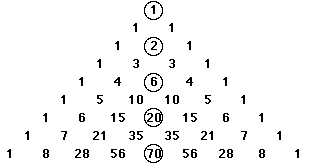
The factors of the central numbers in Pascal's Triangle follow a pattern: - 1 = 1 x 1
- 2 = 2 x 1
- 6 = 3 x 2
- 20 = 4 x 5
- 70 = 5 x 14
- etc
- The numbers in the sequence 1, 1, 2, 5, 14 ... are called the Catalan Numbers.
- What have they got to do with the Bubbles Investigation ?
- Why don't you try the investigation to find out?!!
- If you want to know why Catalan Numbers are important try:
- LINK1 or LINK2 or LINK3 or LINK4---
- 1/7 = 0.142857142857142857142...with repeating cycle (142857).
- Suppose the cycle is reversed to give 0.758241758241758241758... or .(758241)
- What fraction is this? It is 69/91. But 1/7 can be written 13/91.
- 1/13 = 0.(076923) so what fraction is 0.(329670) ? It's 30/91. But 1/13 = 7/91.
- This amazing pattern is worth exploring further! For example:
- 1/91= ? Now reverse the cycle to get ?/91
- 2/91= ? Now reverse the cycle to get ?/91
- and so on ...---
- Some formulae produce lots of primes one after the other...
- n2-n+2=2 for n=1
- n2-n+3=3,5 for n=1,2
- n2-n+5=5,7,11,17 for n=1,2,3,4
- n2-n+11=11,13,17,23,31,41,53,67,81,101 for n=1,2,...10
- Try n2-n+17 for yourself (see a list of prime numbers if needed)
- Now look at Amazing Number Fact No 11
- Can you find other Prime-Rich Formulae?---
- We all know and love the Triangular Numbers 1, 3, 6, 10, 15, 21 ...
- and we all know and love the Square numbers 1, 4, 9, 16, 25 ...
- but how often have we wondered if the only Square Triangular number is 1 ?
- A little calculation might produce the next example.
- A very much longer calculation may produce another.
- However a change of lifestyle would be needed to find 41616, the fourth example.
- And a lifetime may well be too short to find 1413721 the fifth example. Consider the sequence 1, 6, 35, 204 ...
- obtained from the recurrence relation un = 6un-1 - un-2 with u1=1 and u2= 6 .
- Now square each term of this sequence.
- Isn't that amazing!!??---
- 7 is a prime number
- 73 is a prime number
- 739 is a prime number
- 7393 is a prime number
- 73939 is a prime number
- 739391 is a prime number
- 7393913 is a prime number
- 73939133 is a prime number
- 73939133 is an amazing prime number...
- ...if you keep chopping the end digit off you still get a prime.
- It is the largest known prime with this property.
- What's the largest one you can find in The List?---
- A Pythagorean Triple (a,b,c) is a set of three whole numbers which can form the sides of a right-angled triangle. So a2 + b2 = c2.
- You are familiar with the example (3,4,5) giving 32 + 42 = 52.
- Multiples also work ... (6,8,10) and (9,12,15) etc.
- Not so familiar is the fact that there are 18 triples (ignoring multiples) with the two smaller numbers less than 100. Here they are:
3 , 4 , 5 |
12 , 35 , 37 |
33 , 56 , 65 |
5 , 12 , 13 |
13 , 84 , 85 |
36 , 77 , 85 |
7 , 24 ,25 |
16 , 63 , 65 |
39 , 80 , 89 |
8 , 15 , 17 |
20 , 21, 29 |
48 , 55 , 73 |
9 , 40 , 41 |
20 , 99 , 101 |
60 , 91, 109 |
11 , 60 , 61 |
28 , 45 , 53 |
65 , 72 , 97 |
There are some remarkable patterns among these numbers. Can you find any?---
What is special about the number 1395 ?- Well 1395 = 15 x 93.
- It is called a VAMPIRE number with fangs 15 and 93.
- Another example is 1435 = 35 x 41 with the two fangs 35 and 41.
- If you know the fangs, for example 30 and 51, its easy to find the vampire...
- ...but if you meet the vampire, for example 1827, can you find its fangs?
- And how easy is it to spot a vampire hiding among innocent numbers?
- For instance which among 2155, 2170 and 2187 is the vampire?
- Vampire numbers have an even number of digits with their two fangs sharing half that number between them.
- There are exactly seven 4-digit vampire numbers. If you worked through the examples above you should now know five of them. Can you find the other two? One is less than 1395 and the other ...?
- Some large vampire numbers have a spare pair of fangs...
- 125460 = 204 x 615 = 246 x 510
- or even two spare pairs ...
- 13078260 = 1620 x 8073 = 1863 x 7020 = 2070 x 6318
- Now that is amazing!